
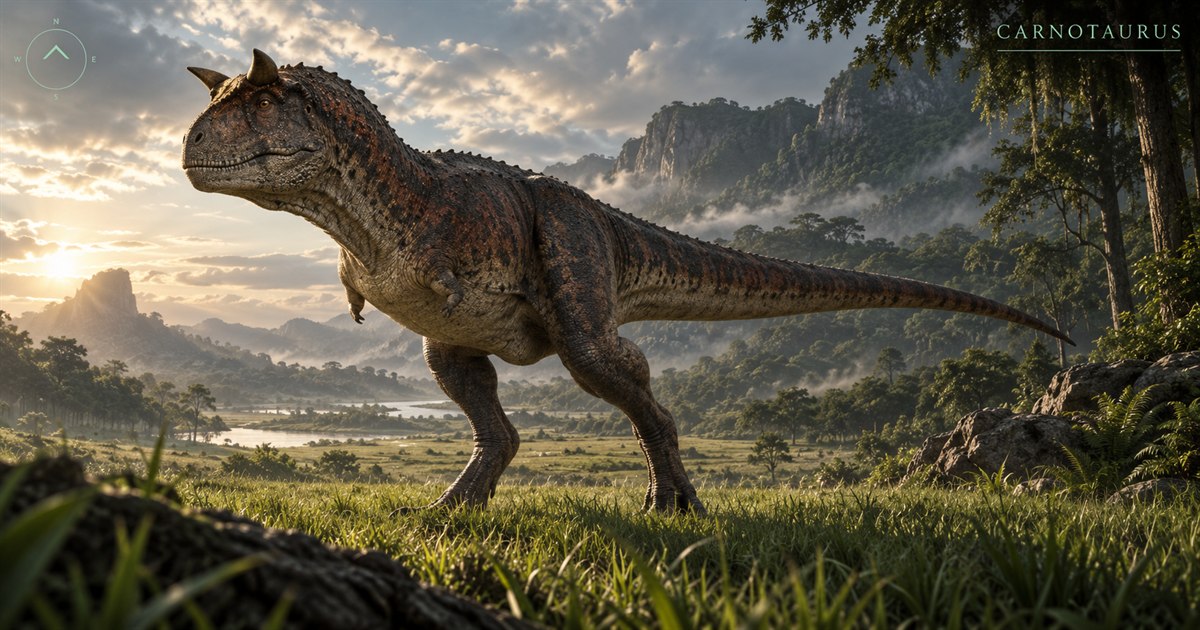
Playing Carnotaurus in The Isle EVRIMA? Learning the charge button is only the beginning. The useful questions are where the attack will finish, whether you can leave after a miss and how much stamina you need for the next decision. A clear approach often matters more than chasing the first animal you see.
This Carnotaurus guide explains charge controls, hunting decisions, diet and juvenile survival on Gateway. It covers EVRIMA, not Legacy. Check your current Controls menu, Status Report and server rules whenever they differ from a guide. The four AI-generated illustrations are conceptual teaching scenes, not official screenshots, exact animations or a live Gateway map.
Carnotaurus controls: the charge input changed
The official patch 0.21.321 announcement describes the headbutt as holding RMB, then pressing LMB while RMB remains held. It says the attack can be activated while standing or running, with its effect depending on preparation time and the animals' relative size. Do not treat an old sprint-only tutorial as the complete control reference.
- LMB: the standard bite reference
- Hold RMB, then press LMB: the headbutt input described in patch 0.21.321; keep RMB held for the attack input
- Shift: the usual sprint input; watch your stamina rather than holding it for every journey
- Hold Q: the usual scent input for finding relevant resource clues
- E: the usual feeding and drinking interaction; follow the visible game prompt
Your own bindings take precedence. Begin in clear space and compare a normal bite, a prepared headbutt and the same preparation while moving. Watch the animation, resource use and recovery before combining them in a fight. If an input does not behave as expected, compare the current game build and control settings rather than repeatedly spending stamina.
There is a reason older videos look different. DevBlog #61 discussed changing the charge from automatic contact damage to an explicit LMB attack. Earlier updates also used different activation conditions. Those are historical explanations, not instructions to expect damage merely from running into another player.
This guide does not prescribe a fixed charge duration, cooldown or knockdown threshold. The live ability state is more useful than a number copied from a different patch. Being able to prepare an attack while standing also does not make every close-range situation a good opportunity to use it.
How to use a Carnotaurus charge without committing blindly
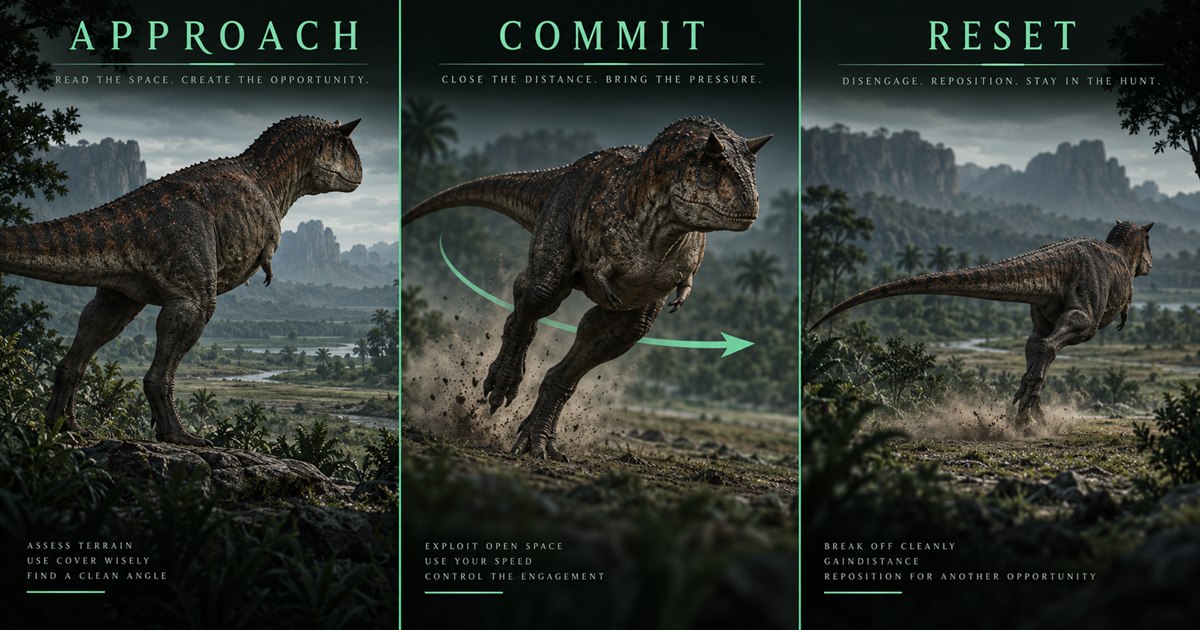
Think of a hunt as three decisions: approach, commit and reset. Before approaching, identify open ground beyond the target. If the attack ends against a tree, rock or steep bank, you have planned the first movement but not what comes after it.
During the approach, check whether the target is actually isolated. Another animal may be concealed at the forest edge, or the target may be moving toward companions. Your speed does not remove the need to look around. Avoid deciding that a hunt is safe merely because you reached the target quickly.
Commit only when the line and distance still make sense. Use the attack input deliberately; contact alone is not the control sequence described in the newer notes. If the target changes direction and the opening disappears, continuing the original plan can turn a manageable encounter into a poor angle.
After an unsuccessful pass, reassess before turning straight back into bite range. Look at the direction you are facing, your stamina and whether you still have clear space. Resetting away from an encounter is a decision, not a promise that the other player will stop chasing.
For example, you spot a potential meal near a narrow gap between rocks. There is room to approach but very little room to continue beyond it. Compare that with an open grassland approach that leaves several directions available afterward. The second option gives you more choices; it does not guarantee a hit or a win.
Carnotaurus stamina: keep a reserve for the next move
Do not spend every trip sprinting just because you are playing a fast-moving carnivore. Travelling, preparing an attack and escaping afterward are separate demands on the same session. Arriving first is not useful if you cannot respond to what you find.
Choose recovery stops before the bar becomes urgent. A stop should offer room to observe and a sensible departure direction. Sitting down at the exact place where another animal last saw you may be convenient, but it does not remove the risk around you.
A practical habit is to check stamina before changing the purpose of a trip. You were walking toward water, then spotted possible food. Ask whether that detour still leaves enough resources for the original journey. If not, solve the immediate need first instead of turning every sighting into a chase.
Use our EVRIMA stamina guide for broader recovery advice. This article does not claim that a particular percentage buys a fixed number of attacks or seconds of escape. Growth, condition, current balance and the actual terrain can change the result.
Carnotaurus diet: check preferred foods before extending a hunt
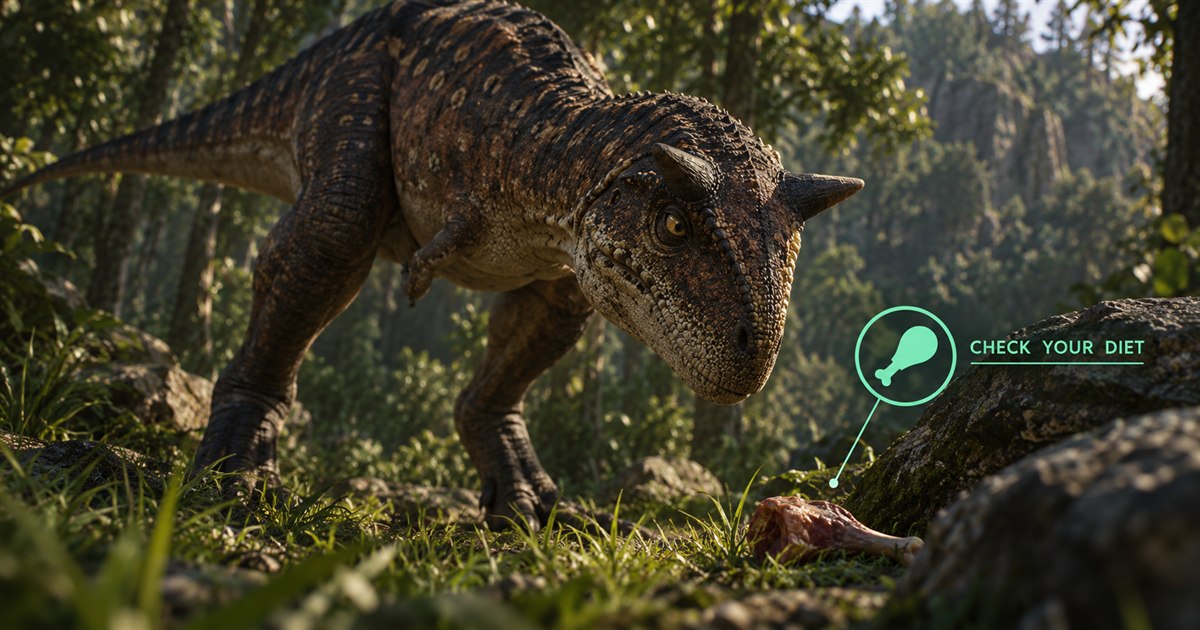
Open the current Status Report and compare your preferred foods with the nutrients you need. Hunger and diet are related, but finding something edible does not automatically complete the nutrient balance you were aiming for. Recheck the bars after feeding rather than assuming the meal solved every need.
Community reference pages can help you learn the species, but fixed food lists and growth timers may lag behind updates. The fan-made Evrima Quick Guide Carnotaurus page itself carries an updating notice. Use the live panel as your food reference instead of planning a long detour around an unverified list.
Assess a food find before lowering your head. Look for movement, nearby calls and approaches another animal could use. A carcass beside open ground may be easy to notice, but it can also be easy for other players to notice. Food is not automatically unclaimed because nobody is currently standing on it.
If hunger is manageable, compare a risky large meal with a smaller option that allows you to keep moving. If hunger is urgent, avoid making the situation worse with an unnecessary contest over a nutrient you do not currently need. These are resource decisions, not rules that every body is safe to inspect.
The food and diet guide explains the wider nutrient loop. Our AI spawns guide explains why an animal marker is a location reference, not confirmation that live prey is waiting there.
Growing a juvenile Carnotaurus on Gateway
A young animal needs a workable routine more than a dramatic first fight. Start by finding your position, identifying a realistic food option and locating a water reference. Keep the first trip short enough that a missing resource does not force a much longer journey.
Do not assume a juvenile can reproduce an adult tutorial's movement or attack results. Practise the inputs your current life stage allows, watch the resource cost and avoid using another player's successful clip as a guaranteed matchup.
Learn a few landmarks instead of crossing unfamiliar terrain whenever you get hungry. If you can recognise the forest edge, a slope and a water approach near your current route, you can make a deliberate return without repeatedly guessing your direction.
For a simple opening routine, check the game panel, refresh your coordinates, choose one resource destination and observe it before approaching. After feeding or drinking, reassess rather than immediately setting off for a second distant destination. The goal is to learn a repeatable local loop, not to claim a permanently safe area.
Gateway routes: food, water and room to leave
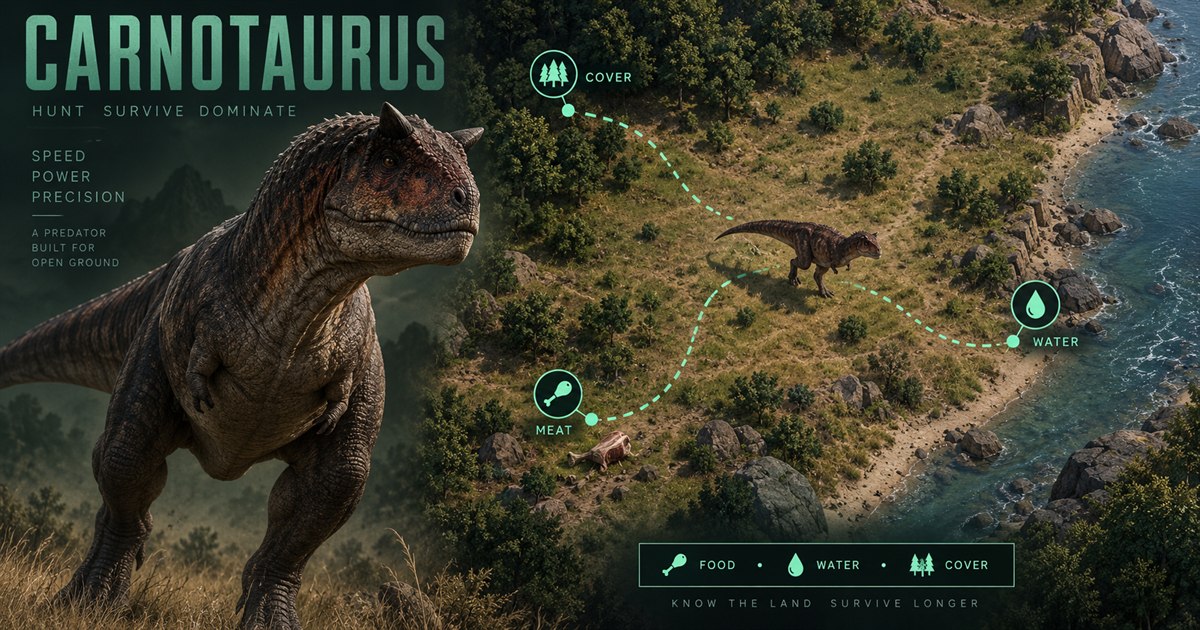
Use a map to understand distance and direction, then compare the suggested destination with the ground in front of you. A short line on a map can still involve rough terrain, a water crossing or a busy approach. The map view does not decide whether your dinosaur can safely make that journey.
Plan water separately from combat. A quiet surface is not proof that no aquatic predator is present. Avoid letting thirst turn into an immediate rush toward the first bank you reach. Read the Gateway water guide and Deinosuchus guide for context, not live warnings about nearby players.
After leaving a contested meal, refresh your position and identify a landmark away from the encounter. Once you have room to observe, decide whether the next priority is recovery, water or another food search. That is more useful than choosing a new hunt before you have finished escaping the old one.
Using TheIsleMinimap while playing Carnotaurus
Enable relevant location names, drinking-water references and animal filters in Map Layers Settings. Compare those references with your own marker and what you can see in The Isle. They do not track live prey or tell you which carcasses are unclaimed.
Refresh the marker by copying Asset Location in the game, or use the enabled screen reader with your confirmed reading area while Lat and Long are visible. Our coordinates and location guide explains setup. Check that the marker is current before using it to choose an important turn.
Private app squads support up to four players. They are separate from The Isle's in-game group limits and server rules. Sharing positions in the app does not authorise an oversized in-game pack.
Carnotaurus questions: controls, charging and hunting
How do you charge as Carnotaurus in EVRIMA?
Patch 0.21.321 describes holding RMB and pressing LMB while RMB remains held. It allows the headbutt while standing or running. Check your own bindings and current build; older tutorials may describe a different input sequence.
Does simply running into prey trigger the attack?
Do not rely on automatic contact damage. Official development notes described an explicit LMB attack, followed by released headbutt instructions using RMB and LMB together. Practise the live sequence before attempting a hunt.
Will a charge always knock down another dinosaur?
No. The released notes describe preparation time and relative size affecting the result. A successful input is not a universal knockdown or kill guarantee.
Is Carnotaurus the fastest dinosaur in The Isle?
It has a speed-focused playstyle, but a universal fastest claim ignores life stage, condition and balance changes. Choose approaches based on your current movement and stamina, not a ranking taken from an older patch.
Is Carnotaurus better than Ceratosaurus?
That depends on the decisions you enjoy learning. This guide focuses on movement and deliberate charge attempts. The Ceratosaurus guide covers scavenging, bacteria and charged bites. Neither article promises a winning matchup simply because you selected one species.