
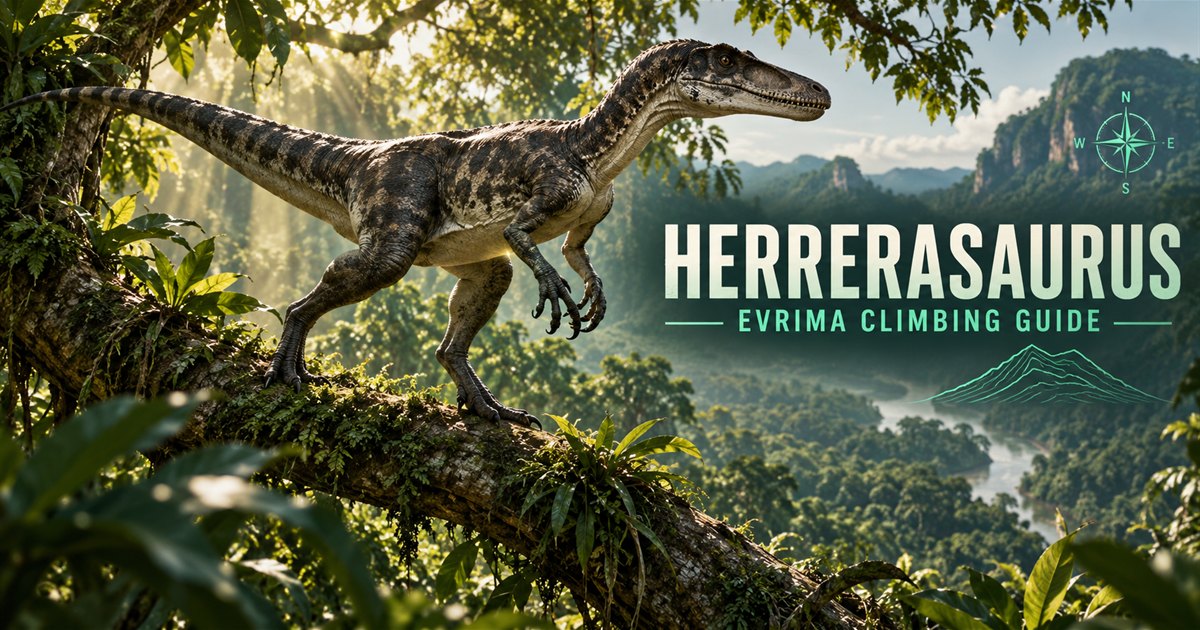
Want to learn Herrerasaurus in The Isle EVRIMA? The useful question is not just how to reach a branch. It is where you will land, what you can observe from there and how you will return after leaving the tree.
This Herrera guide covers climbing controls, tree travel, drop attacks, food and juvenile survival on Gateway. It is for EVRIMA, not Legacy. Check your current Controls menu, Status Report and server rules. The four AI-generated illustrations are teaching concepts, not official screenshots, exact animations or accurate Gateway geography.
Herrerasaurus controls: aim the jump before leaving
The developers' climbing explanation describes holding the right mouse button to aim, then pressing Space to jump from the ground or while climbing. It explains the control design, not a guaranteed jump distance. The released patch notes from December 2023 and January 2024 confirm Herrera's introduction and subsequent adjustments.
The fan-made Evrima Quick Guide carries an updating notice. Its default-input reference is useful to compare with your current bindings:
- Hold RMB, then press Space: aim and perform a jump, including a drop-attack attempt
- LMB: ordinary bite
- Alt + LMB: directional bite input
- Movement keys while attached: move around the climbable surface
- Shift while climbing: faster climbing in the community reference
Learn the movement inputs close to the ground before combining them with a hunt. Watch how the landing indicator changes when you turn the camera, then compare the indicated landing with the result. If your keys are rebound, a tutorial's mouse-button examples may not match your setup.
How to climb as Herrerasaurus without losing the return route
Start with a broad trunk and a reachable branch where you can see the landing. Approach, aim and take one deliberate jump. Once attached, practise moving a short distance up, down and around the surface before trying a transfer to another tree.
A tree that looks convenient from far away may have awkward branches or an approach blocked by foliage. Inspect the whole landing area, not just the nearest edge. A thin branch, rock face or nearby obstacle deserves a different decision from a broad platform you have already tested.
After reaching a perch, turn and inspect the route back. Think of it as a small chain: current perch, next landing and return option. If the next step works only when every part of a long sequence goes perfectly, choose a simpler route while learning.
Check stamina before climbing farther. Spending your reserve getting high can leave you with fewer choices when another animal appears below. Practise an ordinary descent while calm; do not make the first test of your exit control happen during a chase.
Height is useful for observation, not an invulnerability promise. Trees and collision can change with map updates, and other players can still affect the situation. This guide does not claim that every tree is climbable, every fall is survivable or every imperfect jump will automatically be rescued.

Herrera drop attacks: observe before committing
Use the perch to learn what is happening below. Identify the animal, its direction and the ground around it. A target passing through a clearing presents a different exit problem from one standing beside water, rocks or companions.
A drop attack is a commitment to leave your observation position. Before attempting it, choose where you want to land if the target moves. If that alternative is a steep bank or an obstacle-filled gap, wait or change the approach instead of assuming the target will remain still.
Watch the current game's aiming feedback rather than copying a height from a video. This article does not promise a fixed damage multiplier, minimum lethal height or safe fall distance. Growth, conditions and balance changes make those shortcuts unreliable.
After contact or a miss, reassess immediately. Decide whether to move away, return to a tested tree or stop pursuing. Trying to force another attack simply because you left a good perch can make one recoverable mistake much harder to correct.
With friends, agree who is observing and where you will regroup. Several players jumping at once may crowd the landing or leave nobody watching for a new threat. Follow the server's combat rules; a coordinated plan is not permission to exceed them.

Herrerasaurus diet: leave the tree with a purpose
Open your current Status Report and check preferred foods and nutrient needs. Choose a manageable feeding opportunity rather than dropping toward every animal you see. Edible food and the nutrient balance you need are not always the same thing.
Plan the ground trip as a loop: leave a known tree, inspect the food approach, consider a water stop and return to a tested reference. A useful perch does not refill hunger or thirst, and staying high until both needs become urgent narrows your options.
Observe a carcass before approaching. The food may be available while the ground around it is not a good place to linger. Also inspect the drinking bank separately; apparently quiet water is not evidence that aquatic predators are absent.
Use the food and diet guide for the wider nutrient system and the water guide for approach planning. Mapped animal references are not live prey tracking or guaranteed spawns, as explained in our AI spawns guide.

Juvenile Herrera: build a small practice circuit
Pick a few nearby trees instead of testing the tallest landmark first. Repeat short climbs and descents, learn where the branches lead and keep your first food trip close enough to return without improvising an entirely new route.
Do not copy an adult combat clip without considering your current animal. A juvenile's condition and life stage matter. Being able to reach a branch does not prove that you can repeat the attack or escape shown by a larger Herrera.
Keep some reserve for the unexpected ground section. If a familiar landing becomes occupied, you need another option. Our stamina guide helps with travel and recovery decisions without promising a fixed number of jumps.
Gateway navigation for Herrerasaurus and friends
TheIsleMinimap's map layers help relate your latest position to mapped landmarks and resources. A top-down map cannot confirm which branch is climbable, how high you are or whether the next jump will connect. Inspect those details in the game.
Copy Asset Location to update your marker, or use the enabled screen reader with your confirmed area while Lat and Long are visible. It shows your latest accepted reading, not uninterrupted tracking while the panel is hidden. Read the coordinates guide for setup.
Private app squads support up to four players and shared latest positions. The app's four-player squad limit is not The Isle's in-game pack limit. Solo Lifetime provides local navigation; Squad plans include online squad features. See the current plans for available options.
Herrerasaurus questions: climbing and drop attacks
How do you climb as Herrera?
Check your current aim-and-jump binding, practise on a reachable broad surface and learn movement while attached. The default reference uses held RMB followed by Space.
Can Herrera fall or miss a branch?
Do not assume a perch or jump is automatically safe. Test short routes and keep an alternative landing in mind rather than relying on a promised fall distance.
Does more height always mean a better attack?
No height is recommended as a guaranteed winning choice here. The landing, target movement and your exit are part of the decision, not just the height of the tree.
What should Herrerasaurus eat?
Check preferred foods and nutrients in your current Status Report. Use those needs to choose a practical ground trip rather than treating an old species food list as permanent.