
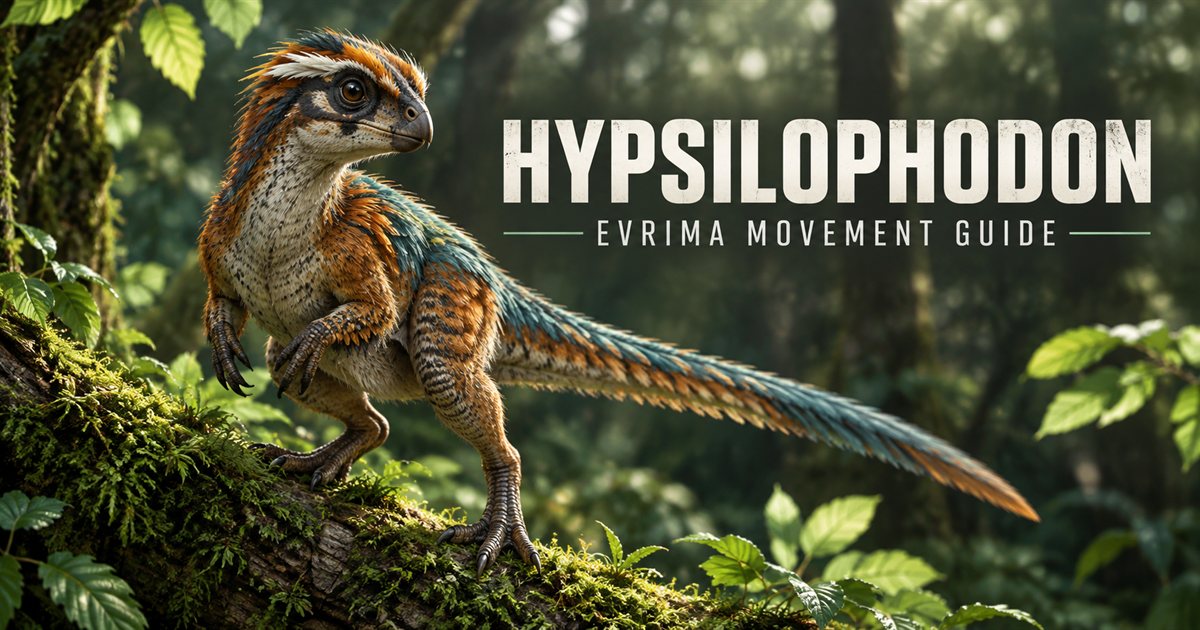
Want to learn Hypsilophodon in The Isle EVRIMA? Treat movement as a sequence of decisions: where you are going, what you expect to land on, and how you will leave afterwards. A successful jump or defensive spit does not automatically solve the next part of the encounter.
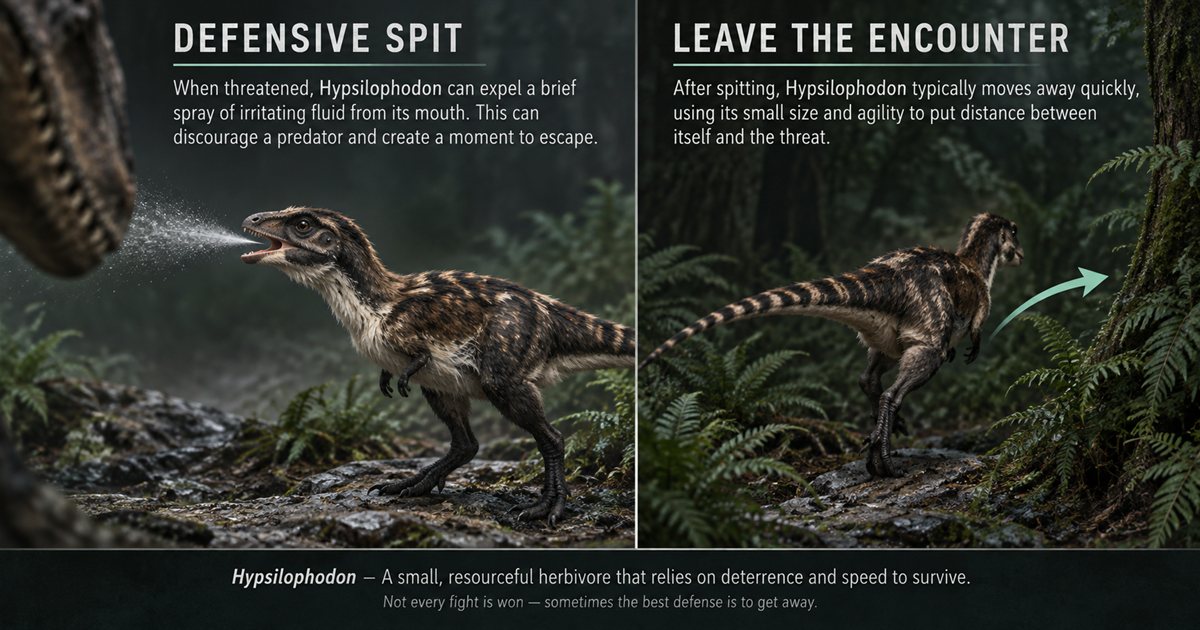
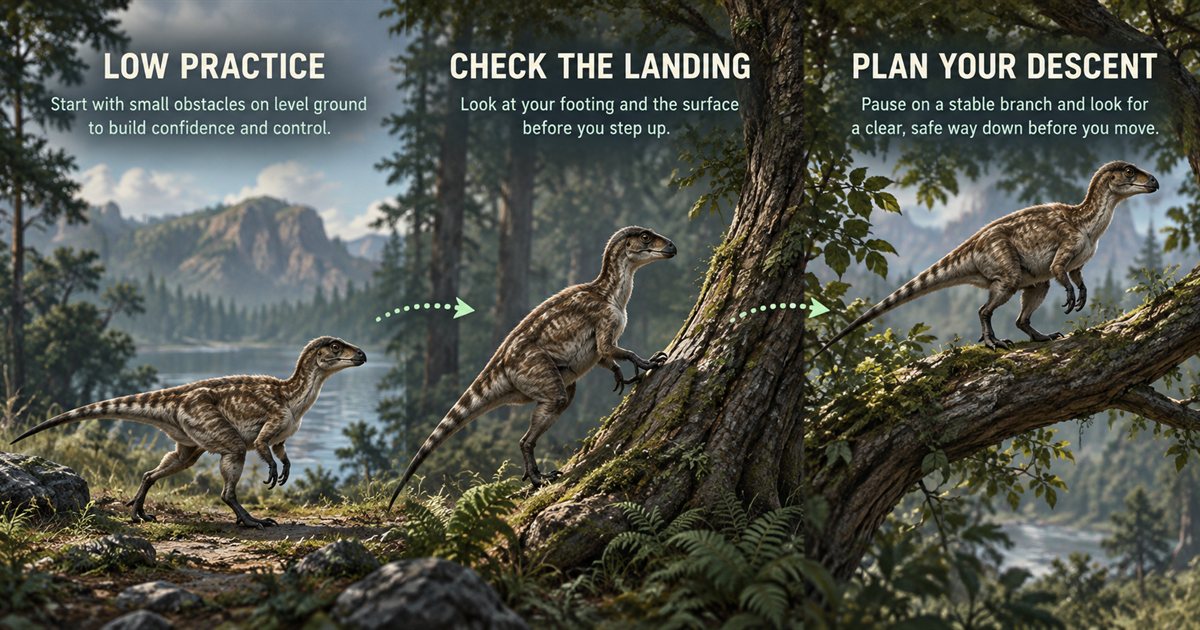
This Hypsi guide covers input practice, spit, latching, food planning and Gateway travel. The three AI-generated illustrations are conceptual examples, not game screenshots, exact ability animations or verified routes. Your current bindings, ability availability and food panel take priority over older references.
Hypsilophodon controls: learn each input separately
The community Hypsi reference lists the controls below and carries an outdated-information notice. Confirm them in your current build, especially if your key bindings are customised.
| Reference input | Listed action | What to check |
|---|---|---|
| LMB | Bite | Separate a normal click from a held input. |
| Hold and release LMB | Aim and release spit | Observe aiming, release and recovery. |
| Hold Space before jumping | Charged jump | Start with a low, visible landing. |
| Hold RMB, then Space | Aimed jump / latch approach | Choose the surface before committing. |
Practise one action at a time on low ground. Establish where the animal ends up and whether you can comfortably regain control. Then combine two actions. Learning everything at once beside a steep drop makes it difficult to tell whether the problem was aim, timing, the surface or a misunderstood input.
Defensive spit: decide what the opening is for
The community reference describes spit as a temporary visual disruption that consumes food. It also notes that hatchlings cannot spit. Check your animal's current availability rather than assuming adult footage applies immediately.
Before aiming, decide where you will move if you get an opportunity. That might be a gap toward cover or ground with fewer obstacles. The purpose is to improve the situation, not to remain beside the opponent while testing whether another shot will connect.
If the target continues to approach, keep judging its actual movement. Do not assume that a visual effect means the animal cannot attack or follow you. A second player may still see the encounter clearly. Move with the whole scene in mind instead of treating the first opponent as the only problem.
Repeated practice can also change the resource situation. Check your own food panel and stop before a demonstration becomes an avoidable feeding emergency. If you are practising with another player, agree on the experiment and follow the server's rules; the game does not enforce that agreement for you.
Hypsi latching is more than jumping onto the nearest tree
The official June 2025 public patch notes added initial Hypsilophodon latching. The preceding development explanation distinguished jumping between latch points from Herrerasaurus-style free climbing. That distinction is useful when older guides simply call both systems climbing.
Begin on a low object where you can see the ground beneath it. Check the approach, the contact point and the landing or departure separately. If a surface behaves unexpectedly, move back to a simpler object instead of testing it at greater height.
Choose a reachable next point before leaving the current one. Look for space to land and for a way to continue or descend. A branch can look inviting from below while offering an awkward position once you arrive. Do not let the next jump become an attempt made only because you cannot explain another way down.
Pause between experiments and check stamina. If you need repeated corrections to find a surface, reset the exercise at low height. A controlled failure close to the ground teaches more than a long fall while you are still learning which input caused the movement.
Ground-level screenshots and map markers do not establish a traversable vertical route. Inspect the surface in the actual game. Avoid assuming that a location useful to a different climbing species will work the same way for your Hypsi.
Hypsi diet: keep movement practice connected to food planning
Read your current preferred foods and nutrient bars before choosing a trip. Work out whether the priority is hunger, an incomplete nutrient or water. A nearby resource is not necessarily the one that answers your current need.
Make the first journey short enough to understand. Identify a return landmark and inspect the feeding area before settling in. After eating, check the result. Change the objective from the bars you actually see, rather than continuing a route because somebody once recommended it.
If you have spent time practising defensive spit, recheck food before beginning a longer movement exercise. It is easier to change plans at a familiar stopping point than halfway between unfamiliar trees. Our food and diet guide explains how to choose resources from the live panel.
Plant references and zone references help exploration. They do not confirm that a plant is present now, that it supplies the nutrient you need in your current build, or that another animal is not feeding nearby.
Travelling on Gateway: plan the descent as carefully as the ascent
Before going upward, decide what you need to do next at ground level. If the objective is drinking or meeting a companion, identify a manageable place to come down. Height is not useful if it makes the practical destination harder to reach.
When joining friends, describe both the landmark and your position relative to it. A companion looking at a ground-level marker may not know you are above them. Agree on a clear rendezvous where both animals can actually meet, rather than trying to force the smallest player through unfamiliar terrain.
At water, look at the approach and departure. A quiet surface and a friend's nearby marker are not proof of safety. Our water guide explains the limitations of a marked resource, and the stamina guide helps with travel and rest decisions.
Young Hypsis: check ability availability before copying an adult
Start with what your current animal can do. Test basic movement in a quiet place and read the game prompts. If a listed ability is unavailable, do not keep repeating its input beside a threat; make a plan using the actions you actually have.
Choose a familiar resource loop and a practical meeting point. Protecting progress may mean avoiding a fight or postponing a difficult ascent. A short successful journey can teach the area more effectively than trying to follow an adult's entire route on the first session.
For progression and family play, use our growth guide and nesting guide. Development previews of nest features should be checked against the branch you are playing before you build a session around them.
Using TheIsleMinimap with a small, mobile herbivore
Use Map Layers to compare location and relevant resource references with your next objective. Copy Asset Location, or enable approved local reading while Lat and Long are visible. The marker shows your latest accepted coordinate update; it is not continuous tracking while the coordinate panel is hidden.
Squad plans add a private app group for up to four players, while Solo Lifetime supplies local navigation. App squads are separate from The Isle's in-game grouping rules. The app does not read spit availability, food or stamina, evaluate climbable surfaces, reveal hidden players, or perform jumps.
For another small-herbivore approach, read our Dryosaurus evasion guide. For ground-based herd coordination, compare the Diabloceratops guide.
Hypsilophodon questions
Does Hypsi climb exactly like Herrerasaurus?
The official development explanation distinguishes their systems. Learn your Hypsi's latch-and-jump behaviour on low objects rather than copying another species' route.
Does spit guarantee that a predator cannot catch me?
No. Use any opening to improve your position and continue observing the approach. An affected animal can remain dangerous.
Can the minimap plan a route through trees?
No. It supplies map references and accepted positions. You must assess surfaces, landing points and descent choices in the game.